Abfall und Transportgesetzgebungen habe weitreichende Auswirkungen auf die alltägliche Recyclingwirtschaft. Unterschiedlichste internationale, nationale und regionale Regelwerke, Verordnungen und Gesetze greifen ineinander und machen insbesondere grenzüberschreitende Abfallverbringung zu einem komplexen Vorgang. Die Wichtigsten davon sind nachfolgend umschrieben und zu ausführlichen Quellen verlinkt.
UN United Nations
In Bezug auf Batterierecycling und -transport reguliert die UN zwei Gesetzesbereiche:
GHS (Globally Harmonized System of Classification, Labelling and Packaging of Chemicals)
Dieses System regelt die Klassifizierung und Kennzeichnung von Chemikalien, sowie standardisierte Darstellung in öffentlich zugänglichen Sicherheitsdatenblättern. Es wurde 2008 in europäisches Recht (EC/1272/2008) umgesetzt und gibt damit Hilfestellung wann ein Abfall als un- oder gefährlich einzustufen ist. Zudem beinhaltet es einen Leitfaden zur Bestimmung Gefahr angepasster Verpackungen.
UNECE (United Nations Economic Commission for Europe and Executive Committee)
Diese UN-Unterorganisation entwickelt Vorschriften für den Straßen- (ADR) und Wassertransport (ADN) von gefährlichen Gütern. Ihre Richtlinien beinhalten konkrete Verpackungs- und Transportmaßnahmen für Produkte und Abfälle, wenn diese gefährliche physikalische und chemische Eigenschaften aufweisen.
Basler Übereinkommen
Das Basler Übereinkommen (Basel Convention on the Control of Transboundary Movements of Hazardous Wastes and their Disposal) ist ein multinationales Abkommen, dass in allen Ländern automatisch in Kraft tritt, die dieses Übereinkommen über die grenzüberschreitende Verbringung von Abfall unterzeichnen. Es regelt die Mindestinformationsangaben durch Abfallerzeugern, Transporteur und Entsorger, sowie die Zuständigkeiten von Behörden, Sicherheitsleistungen und Information der Öffentlichkeit.
Basel Convention
Europäische Gesetzgebung
EG/1013/2006 Verordnung über die Verbringung von Abfällen
Waste ShipmentDiese Verordnung ist gleichsam in allen Ländern der europäischen Union wirksam und basiert auf dem Basler Übereinkommen. Für alle Beteiligten der Abfallverbringung (Erzeuger, Transporteur, Entsorger und entspr. Behörden) benennt es Aufgaben und Verantwortlichkeiten, sodass ihnen alle notwendigen Detailinformationen den Akteuren und Öffentlichkeit über die Abfallverbringung zur Verfügung stehen.
EG/2006/66 Verordnung über Altbatterien und Akkumulatoren
Battery RegulationDie Verordnung regelt Anforderungen an Batterien entlang ihres gesamten Lebenszyklus als Bestandteil der EU-Nachhaltigkeitsstrategie. Sie ist in vielen Aspekten als Minimalanforderungen formuliert und ist gleichlautend in allen 27 Mitgliedsstaaten gültig. Untergesetzliche Regelwerke legen Ausführungsdetails fest.
- Die Sammlung von Altbatterien muss verschärften Zielvorgaben genügen: Gerätebatterien 45 % bis 2023 (63 % bis 2027, 73 % bis 2030). Für Batterien für leichte Verkehrsmittel ist eine Quote von 51 % bis 2028 und 61 % bis 2031 vorgesehen.
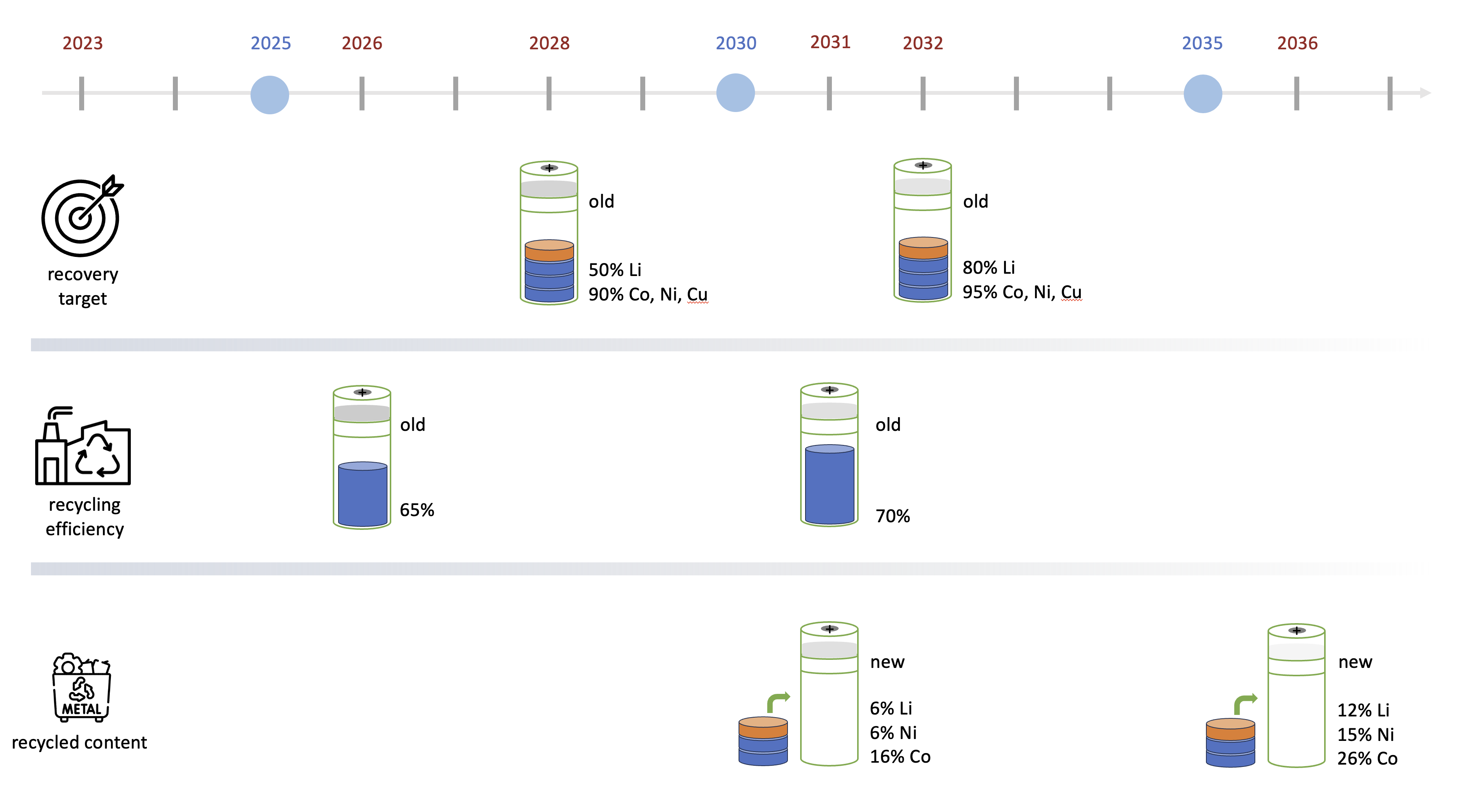
- Die stoffliche Verwertung von Altbatterien fordert Quoten von: Lithium 50% bis 2027 (80% bis 2031); Kobalt, Kupfer, Blei und Nickel 90% bis 2027 (95% bis 2031)
- Ein Mindestgehalt recycelter Inhaltsstoffe ist zur Verwendung in neuen Batterien vorgesehen (ebenfalls zu berücksichtigen: Abfällen von Batterieproduktionen, aber keine Gerätebatterien < 2kWh)
- Ab 18.08.2031: 16% für Kobalt, 85% für Blei, 6% für Lithium und 6% für Nickel
- Ab 18.08.2036: 26% für Kobalt, 85% für Blei, 12% für Lithium und 15% für Nickel